
Effects of litter quality and floor heating on foot pads
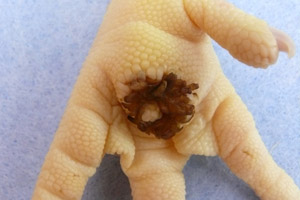
Food pad lesions reflect on bird health and welfare. It deserves more attention for ethical reasons and consumer desires. What is the cause and what can be done about it?
By Dr Amr Abd El-Wahab and Prof Dr Josef Kamphues, University of Veterinary Medicine Hannover, Germany
Foot pad dermatitis (FPD) has been known as a common problem in poultry production for many decades. Recently it attracted additional attention in terms of animal welfare, food safety and also consumer protection, since predisposing conditions for foot pad diseases are influenced by infections of the gastrointestinal tract and may also be related to zoonoses.
FPD is basically a type of contact dermatitis affecting the plantar region of the feet, with lesions surrounded by a reddening of the foot pads as a first symptom, followed by discolouration and hyperkeratosis, often in combination with erosions and necrosis of the epidermis, with deep ulcers occurring in severe cases. Furthermore, the lesions can be a gateway for bacteria which may spread haematogenously and might impair product quality. It has been indicated that broilers with severe FPD show reduced weight gain, which has been suggested to be a result of pain induced inappetance.
Causes of foot pad lesions
The aetiology of FPD is complex; it is an interaction of different factors. Some of these are related to management and housing including litter quality, management and type of litter. Furthermore, FPD is related to dietary factors. Finally, diseases could interfere with FPD caused by various gastrointestinal infections. Birds spend most of their productive life in close contact with the bedding/litter material. It is commonly accepted that litter moisture is a significant factor in the onset of FPD.
The aetiology of FPD is complex; it is an interaction of different factors. Some of these are related to management and housing including litter quality, management and type of litter. Furthermore, FPD is related to dietary factors. Finally, diseases could interfere with FPD caused by various gastrointestinal infections. Birds spend most of their productive life in close contact with the bedding/litter material. It is commonly accepted that litter moisture is a significant factor in the onset of FPD.
Recent studies however stated that pure water (without excreta) alone is already sufficient to produce severe lesions on the foot pads. Standing on wet litter has been suggested to soften the foot pad and to become more prone to damage, predisposing the birds to develop FPD. It was noted that the first marked increase in FPD lesions in turkey poults occurred after experimental exposure for only 4 h/d to a ‘critical litter moisture’ of 35% (i.e. 350 g water per kg mixture of litter and excreta).
Wet litter
Poor litter quality is considered nowadays a welfare problem in modern poultry production and hence research should focus on developing measures for upgrading litter quality. There is no doubt that wet litter will increase the prevalence and severity of FPD. Thus, all factors that affect the litter quality (especially moisture content) directly or indirectly are of special interest. But a critical question should be allowed: Is litter really the right focus?
Poor litter quality is considered nowadays a welfare problem in modern poultry production and hence research should focus on developing measures for upgrading litter quality. There is no doubt that wet litter will increase the prevalence and severity of FPD. Thus, all factors that affect the litter quality (especially moisture content) directly or indirectly are of special interest. But a critical question should be allowed: Is litter really the right focus?
Litter is a mixture of bedding materials with increasing amounts and proportions of excreta. At the end of the fattening period the proportion of excreta will exceed 90%, which means that less than 10% is litter material. During production the excreta (faeces and urine) releases its water content to the air which in turn is transferred out of the barn by ventilation. This underlines the importance of ventilation and arises the question what factors influence the water release from the excreta and/or the mixture of litter with excreta and the transfer to the air above the litter surface. It is well known that “layers of excreta” on the litter surface impair the process of drying markedly. What role does the “physical structure” of excreta – particle size and proportion of rough particles that present surfaces – play on the drying process. There is no doubt that wet litter induces FPD but why doesn’t the litter get dry easily?
Type of litter
Litter plays an important role in moisture management. It should not only be able to absorb moisture but should also have a reasonable drying time. Bedding materials with sharp edges may contribute to FPD by opening small puncture wounds on the foot pad which can lead to entry of bacteria and probably to FPD. Straw tends to have higher moisture content as well as higher ‘caking’ scores, resulting in a higher incidence of foot pad lesions.
In recent years wood shavings have become the most frequently used bedding material, however there is a new litter type with growing potential and that is lignocelluloses produced from wood by chopping the wood into fine particles which are then pressed into pellet form using steam and high temperature. Results (Figure 1) show that lignocellulose reduces the severity of FPD significantly, which could be attributed to its higher absorbing capacity and also quick release of water. Nevertheless, from an economical point of view, lignocellulose will never be used for the whole fattening period (20 weeks) in turkeys, due to its high costs (~12.5 kg/m2 = ~5 €/m2). But some people hypothesise that very good litter conditions in the rearing period would offer advantages for the following fattening period. This suggests that using lignocellulose in the rearing period and wood shavings in the fattening period could economically be an acceptable option.
Trials showed indeed that in the first six weeks of rearing turkeys, lignocellulose caused significantly lower FPD scores compared to wood shavings. However, with shifting from lignocellulose (after those six weeks) to wood shavings until end of the fattening period did not result in marked differences in comparison to those housed continuously on wood shavings. This makes lignocelluloses not suitable as a litter material for rearing turkeys, but it could be promising for broiler production due to their shorter rearing period and the lower amounts of bedding material used.
A really new alternative is the use of artificially dried maize silage as a litter (supplied by some biogas system operators), since it proves to have a positive effect on reducing FPD.
Floor heating
Several producers make use of floor heating to create a comfortable floor temperature and dry litter. This resulted, independent of other factors (type of litter, diet composition, artificial infection) in a reduction of FPD by ~53 %, which is believed to be the result of drier litter. Whether that is true is to be tested critically, because floor heating might lead to a “warm foot pad” causing vasodilatation of the blood vessels, increasing the blood flow and promoting healing.
In the absence of floor heating the litter is quite cool, which may lead to blood vessel constrictions in the foot pad causing a “cold wet foot pad”. The source of heating in turkey houses usually hangs above the floor making the surface of litter warm, but leaving the bottom at a reduced temperature.In a recent study using electrical floor heating (35ºC) at litter surface, distinct interesting interactions could be demonstrated. For example, in spite of high electrolytes levels in the diet no detrimental effects occurred regarding litter quality and/or foot pad health. Although the water intake increased – when birds were housed with floor heating – the litter had higher dry matter content, indicating that floor heating favoured markedly the evaporation of water. In general this would indicate that floor heating could be recommended for the first weeks of the birds’ life.
Experimental work showed that in young turkeys using floor heating with lignocellulose resulted in lower FPD scores compared to those housed continuously on wood shavings containing 35% water.
Coccidiosis, as we all know, plays a major role in the development of FPD due to diarrhoea and subsequent increased moisture in the litter. However when using floor heating, significantly less FPD was seen compared to groups not using floor heating. Despite induced diarrhoea due to coccidiosis, the litter was drier when floor heating was used. Although floor heating seems to be a promising solution for minimising FPD, there is besides the economical aspect also a need to look at ‘side effects’ of floor heating, since higher airborne dust levels are measured in barns with floor heating. Meanwhile producers should be aware that with well balanced diets, at a proper stocking density and good health without gastrointestinal infections, there will be no need to implement floor heating. However, with floor heating they can overcome diverse mistakes made during diet formulation/misdosing of anticoccidials to guarantee high litter quality and to avoid FPD.
In recent years wood shavings have become the most frequently used bedding material, however there is a new litter type with growing potential and that is lignocelluloses produced from wood by chopping the wood into fine particles which are then pressed into pellet form using steam and high temperature. Results (Figure 1) show that lignocellulose reduces the severity of FPD significantly, which could be attributed to its higher absorbing capacity and also quick release of water. Nevertheless, from an economical point of view, lignocellulose will never be used for the whole fattening period (20 weeks) in turkeys, due to its high costs (~12.5 kg/m2 = ~5 €/m2). But some people hypothesise that very good litter conditions in the rearing period would offer advantages for the following fattening period. This suggests that using lignocellulose in the rearing period and wood shavings in the fattening period could economically be an acceptable option.
Trials showed indeed that in the first six weeks of rearing turkeys, lignocellulose caused significantly lower FPD scores compared to wood shavings. However, with shifting from lignocellulose (after those six weeks) to wood shavings until end of the fattening period did not result in marked differences in comparison to those housed continuously on wood shavings. This makes lignocelluloses not suitable as a litter material for rearing turkeys, but it could be promising for broiler production due to their shorter rearing period and the lower amounts of bedding material used.
A really new alternative is the use of artificially dried maize silage as a litter (supplied by some biogas system operators), since it proves to have a positive effect on reducing FPD.
Floor heating
Several producers make use of floor heating to create a comfortable floor temperature and dry litter. This resulted, independent of other factors (type of litter, diet composition, artificial infection) in a reduction of FPD by ~53 %, which is believed to be the result of drier litter. Whether that is true is to be tested critically, because floor heating might lead to a “warm foot pad” causing vasodilatation of the blood vessels, increasing the blood flow and promoting healing.
In the absence of floor heating the litter is quite cool, which may lead to blood vessel constrictions in the foot pad causing a “cold wet foot pad”. The source of heating in turkey houses usually hangs above the floor making the surface of litter warm, but leaving the bottom at a reduced temperature.In a recent study using electrical floor heating (35ºC) at litter surface, distinct interesting interactions could be demonstrated. For example, in spite of high electrolytes levels in the diet no detrimental effects occurred regarding litter quality and/or foot pad health. Although the water intake increased – when birds were housed with floor heating – the litter had higher dry matter content, indicating that floor heating favoured markedly the evaporation of water. In general this would indicate that floor heating could be recommended for the first weeks of the birds’ life.
Experimental work showed that in young turkeys using floor heating with lignocellulose resulted in lower FPD scores compared to those housed continuously on wood shavings containing 35% water.
Coccidiosis, as we all know, plays a major role in the development of FPD due to diarrhoea and subsequent increased moisture in the litter. However when using floor heating, significantly less FPD was seen compared to groups not using floor heating. Despite induced diarrhoea due to coccidiosis, the litter was drier when floor heating was used. Although floor heating seems to be a promising solution for minimising FPD, there is besides the economical aspect also a need to look at ‘side effects’ of floor heating, since higher airborne dust levels are measured in barns with floor heating. Meanwhile producers should be aware that with well balanced diets, at a proper stocking density and good health without gastrointestinal infections, there will be no need to implement floor heating. However, with floor heating they can overcome diverse mistakes made during diet formulation/misdosing of anticoccidials to guarantee high litter quality and to avoid FPD.
| Recommendations for FPD management 1. Keep the litter around drinking and feeding places as dry as possible, as even short exposure to wet litter will increase the severity of FPD markedly. Changing water line positions could be an effective but costly option. 2. If there is a surplus of energy or heat, it should be used for floor heating. However, some people prefer to warm the incoming air instead of heating the floor, but in the summer there is a need to cool incoming air. This supports the application of floor heating because it is so effective. 3. In farms with a high prevalence and severity of FPD, the veterinarian should look at diet composition (high dietary soybean meal, surplus of electrolytes) as well as at gastrointestinal infections. The key point is litter quality. Litter can be kept dry using floor heating which enhances animal health and welfare. |





 Beheer
 WP Admin
  Bewerk bericht