-
The headquarters of the 200 square kilometres large complex of Al Watania are based in Al Qasim, Saudi Arabia.
-
Strict hygiene protocols stipulate that all vehicles that must pass a sanitation gate before entering most of the premises at the complex.
-
So far, Al Watania is still using multistage incubators in their four hatcheries. These are checked permanently and kept in excellent condition, thus ensuring good hatching results.
-
Electronic controls are kept outside the hatcher rooms in the central corridor. Thus intensive wet cleaning with detergents and disinfectants will not cause failures to these systems.
-
Despite the multi stage incubators, high hatchability results of up to 90 percent are achieved. This is thanks to very strict control and intensive maintenance.
-
In order to prevent the day old chicks from diseases such as ND and ILT they are vaccinated in the hatchery, which is using a carousel for this purpose.
-
Motivated vaccination staff of many different nationalities enjoy being photographed.
-
Day old chicks are taken by own trucks to one of the growing houses at Al Watania.
-
Al Watania is growing broilers in 714 houses on 26 different farms.
-
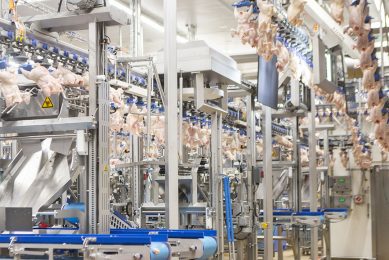
After a 30 day growing period the birds are taken to slaughter in one of the three plants at the processing department.
-
To prevent the birds from being exposed to the hot Saudi climate, they are taken into the building immediately. The roof of the truck can be lifted hydraulically to allow fresh air to flow around the birds.
-
The Saudi market demands small birds which have been grown for only 30 days. They are killed 100 percent hallal, thus in full accordance with the Islamic law.
-
A large part are sold as whole birds, but further processing is also gaining ground in Saudi Arabia.
-
In the further processing plant, small sausages are made...
-
... but also big smoked chicken sausages in many different tastes.
-
Chicken and chicken products are packed and sold at the Saudi market, but also exported to other countries in the Gulf area.
-
Nowadays the further processing plant at Al Watania is producing no less the 62 different products, says manager Ashraf Ezzat Ahmed.
-
Al Watania is supplying their meat products under their own name to outlets all across the Kingdom of Saudi Arabia.
-
Two layer farms have a total capacity of one million table eggs per day.
-
The layer houses and cages were built 1983 by Lohmann Cuxhaven and are still meeting with today's demands.
-
Layer division manager Dr. Taha M. El-Tanab: "We are very keen on bio security. Therefore we are moving pullets from the rearing to the layer division house to house".
-
The layer houses on each farm are connected through a central corridor. Two conveyor belts are taking the eggs to the grading and packing station.
-
Each layer farm has its own grading and packing station where the inline conveyor belts are feeding the Moba machines.
-
The sorted eggs are packed in boxes under the Al Watania brandname. If necessary, they can be stored in the huge cooled storage room which is connected to the packing station.
-
Al Watania has its own transport division, consisting of a major fleet of trucks for various purposes.
-
The full integration approach involves that Al Watania is producing their own feed for which they have four feed mills.
-
Total capacity of the four feed mills is 1,400 tonnes daily.
-
"We have plans for major expansion in Saudi Arabia and in Egypt", say Mosaed Yahya Al Saleim (general manager, middle), Abdulrahman S. Al-Dhabaan (marketing director, right) and production manager Dr. Mohammad Najeeb Ramzan (left) of Al Watania.
-
At the premises, Al Watania have facilities for their own staff, such as grocery stores.