
Breeding a healthier hen is possible
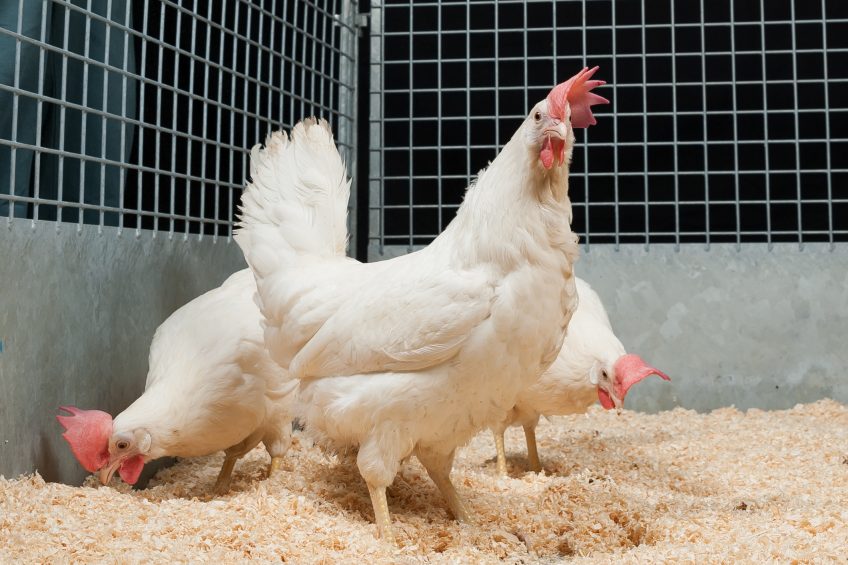
Postdoctoral researcher Tom Berghof discovered that it’s possible to breed selectively on the amount of ‘natural antibodies’ (NAbs) in laying hens. And perhaps more importantly, NAbs are predictive in terms of disease resistance.
For decades, there has been demand from commercial poultry farms for hens with the highest possible resistance to diseases. “Especially since in an increasing number of countries worldwide, antibiotics may not be used as a preventive measure to combat disease, you see that the demand for laying hens with a higher natural disease resistance is increasing,” says Tom Berghof, postdoctoral researcher at Animal Breeding & Genomics at Wageningen University & Research (WUR). Although in some European countries the number of animals per square metre in poultry houses is decreasing, in other countries in the world, for example Brazil, China, Russia and the US, there are often relatively higher number of animals kept per square metre. And as always, the more animals kept together, the higher the risk of disease. European countries that opt for organic farming activities also need animals with a higher resistance as these animals usually walk outdoor and thereby might be affected by disease.
That’s why Hendrix Genetics together with the departments of Animal Breeding & Genomics, and Adaptation Physiology of Wageningen UR in 2012 set up the research ‘Divergent Selection for NAbs (Natural Antibodies) in Poultry’. Berghof says, “In 2013 I was recruited as the PhD researcher for this project and a few weeks ago I received my doctoral title based on this study.” In 2013 and 2014 the now postdoctoral researcher investigated the heritability of natural antibodies (NAbs) in laying chickens. The predecessor of Berghof, Laura Star, showed in 2007 that if laying hens have more NAbs, there’s a lower chance of mortality compared to laying hens with less NAbs. “This relationship suggests it says something about the level of disease resistance of a hen,” Berghof adds.
Breeding for health
Whether NAbs really have a protective effect or are only an indication of the protective effect, cannot be concluded based on this research, according to Berghof. “We have mainly focused our research on whether it’s possible to breed on lower or higher levels of NAbs. We do know that research in humans and mice showed that NAbs really can have a positive impact on health.” If we go back to the heritability, then 10 to 15% of the total variation is due to the genetic differences between animals.
The research was set up as follows: Berghof first determined the heritability in a base population. After that, he started breeding divergently. “We therefore had a ‘low’ line with chickens with less NAbs and a ‘high’ line with chickens with more NAbs. These 2 lines we bred for 6 generations. Every generation is around 35 weeks long.” During the research the postdoctoral researcher observed a very clear selection response; with every generation the difference between the low and high line increased. Berghof states, “That’s already a first important research result. So, you can breed on the amount of NAbs in laying hens. And perhaps more importantly; this is also predictive in terms of disease resistance.” During the research the low and high line were housed mixed with the control group in one stable. “The reason is to keep the environmental effects, which we know affect the NAb levels, equal. We don’t know, how those environmental effects influence the NAbs exactly,” he says.

Considerably less mortality
To test if there was a true protective effect, generation 4 and 6 were infected with E. coli bacteria at 8 days old. Subsequently, both lines were observed for 1 week to investigate the mortality rate. Berghof states, “We found that the high NAb line had 2 to 3 times less chance to die than the low NAb line. To be exact; in the 4th generation the mortality in the low line was 24% and in the high line only 9%. In the 6th generation the mortality in the low line was 13% and 7% in the high line. I do have to mention that we have used an extremely high dose of E. coli to see really clear differences.”
At the end of each trial, an autopsy was carried out on all animals, both on the dead chickens as well as those that were still alive. What emerged was that the high NAb line copes much better with the E. coli than the low NAb line. “In the high line chickens we saw either they had less organ damage or, though they were infected, they had no organ damage at all. In this regard, we suggested that breeding on NAbs is possible and that it might be an indication for disease resistance. So, you can use NAbs to really breed for disease resistance. That’s the main conclusion of my research after 4 years.”
One specific gene determines predisposition
In addition to all the results from the research ‘Divergent Selection for NAbs (Natural Antibodies) in Poultry’ Tom Berghof, discovered something special. “In 2018 we discovered in one specific gene in our base population, that is responsible for a large amount, for around 60%, whether the hen is predisposed for low or high NAbs.” This gene is a so-called TLR (toll-like receptor) and more specifically the TLR 1A. TLR’s are disease receptors, a sort of sensor for pathogens, which activate the immune system. They recognise parts of bacteria and viruses, which are present on many different bacteria and viruses. Thereby they can target a wide range of pathogens at the same time.
Follow-up research
Of course it’s also the question whether breeding on NAbs influences the production characteristics of the hen. Berghof adds, “We also had a look at this. Breeding on NAbs seems to have, as far as we’ve observed, no strong relationship with the egg production and egg characteristics of hens.” Of course the White Leghorn hens (one of the mother lines) of Hendrix Genetics, which are used for this research, were held under exact same environments and received exactly the same feed. Berghof states,“The body weight of the high NAb line was in the rearing period higher than those of the low NAb line. As soon as they came into production, the weights were again on the same level.”
In addition, a follow-up study on his research by postdoctoral researcher Marleen Visker of Animal Breeding & Genomics of Wageningen UR is currently going on. # “She is currently researching where the differences between the low and high lines come from and what differences these differences are,” mentions Berghof. According to Frans van Sambeek, director R&D Hendrix Genetics Layers, Visker is currently investigating how these research findings can be applied into the breeding programmes of pure bred lines. Van Sambeek says, “At this moment, we are running 3 field experiments with layers with high or low NAb levels. These hens will be monitored for liveability and production.”
Visker, in collaboration with Hendrix Genetics, is doing field trials with more than 8,000 animals in total spread over three locations in the world. 2 of these locations are in the Netherlands and one in Canada. In these stables, 3 groups of animals, namely a control group and a low and high NAb cross-breeding are monitored. Berghof adds, “In contrast to my research, they use the common crossing products which is used by commercial poultry farms. In my research, we used the mother line all the time.” The practical trial of Visker will be finished within half a year, around September 2018. “In the months after the research, the results will come out,” he says.
Cheap to determine
Finally, according to Berghof, is important to mention that NAbs are relatively easy and cheap to determine in very large numbers by the ELISA method. “While it, both animal welfare and economically, only has benefits. Also by breeding for high NAb lines, the worldwide use of antibiotics can be brought back to an even lower level. That is why the department of Animal Breeding & Genomics, and Adaptation Physiology of Wageningen UR are also investigating if our research results can be useful for other animal species, for example broilers (breeders), pigs, and dairy cows.”
Join 31,000+ subscribers
Subscribe to our newsletter to stay updated about all the need-to-know content in the poultry sector, three times a week.




 Beheer
 WP Admin
  Bewerk bericht